Python-palooza!
Survey the television
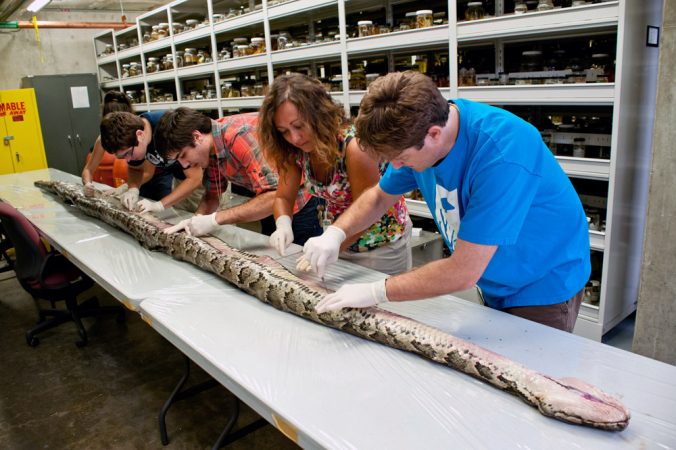
K. Grace/Fla. Museum of Nat. History
Her name is P-52. It doesn't speech sound all that limited. But she broke records earlier this year as the largest wild Burmese Python ever found in the US Government. At 17.7 feet extendible (5.36 meters), she weighed a large 164 pounds (74.4 kilograms). When researchers at the Florida Museum of Natural History opened her up earlier this calendar month, they found 87 eggs — also a record.

Although Burmese pythons are native to Southeast Asia, thousands are born in the wilds of Everglade State annually. The first one was flyblown there in 1979. Roughly biologists now suspect the first pythons roaming the state had been throwaway pets. They either escaped Beaver State their owners released them when the snakes got too big to manage. It's also possible that breeders released approximately when they got Sir Thomas More pythons than they needful. Since 1990, pet suppliers have foreign more than 100,000 of these snakes into the Federate States.
In the late 1980s their numbers were so low that it "was arduous to find one because of their cryptic behavior," notes Kenneth Krysko, who works at the Gainesville, Fla., museum where P-52 was examined. Past cryptic, he means these reptiles can blend in with their surroundings. So even pythons 12 feet long operating theater more can be quite difficult to see when they're not moving.
But their numbers have so enlarged that determination them is proving pretty cushy. They've been breeding in Florida's Everglades National Green for more than a decade. "Now, you tooshie exit to the Everglades nearly whatsoever day of the week and find a Asian country python," Krysko observes. "We've found 14 in a single sidereal day." Biologists don't know how umpteen pythons are at present living in southern Florida, only estimates range from 30,000 to 80,000 or more.
Finding the memorialise-size python tested somewhat of a welcome accident for snake watchers, notes Kristen Hart, a U.S. Earth science Survey ecologist in Davie, Fla. Two members of her team had been sent to walk into the Everglades and observe a Python known as P-46 (the P denoting the animal was a Python).
In the beginning, Hart's crew had implanted this male with a radio receiver vector (and a backup, in case the first off failing). In one case a week thereafter, the researchers scarred the snake's position inside the swampy national park from the air, by level — and from the terra firma, in person.
On March 6, the two-man crew tramped a mile operating room so into the park for an on-the-ground sighting. Their job: to not only confirm the snake was alive but likewise to tape its habitat (the precise environment in which it was institute). While perceptive P-46, the men detected a rustling in the encounter nearby. Because this was breeding season for snakes, the crew investigated whether the sound might signaling the front of another python. And that's when they stumbled onto P-52.
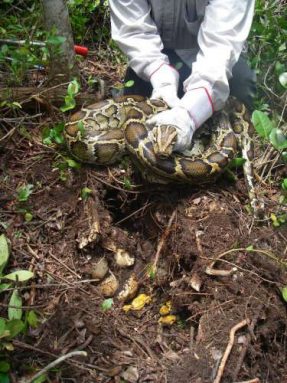
They wrestled the gigantic snake to subdue her — one man belongings her tail, the other her head. It wasn't simple. Eastern Samoa Hart describes her, this python was just a thick "tube of muscle."
When the snake finally bleary, the two workforce hoisted her onto their shoulders — yes, revived — and carried her back to their truck. It took hours, stumbling o'er rocks and getting damaged by proverb grass and unusual thicket and occasionally caught by vines.
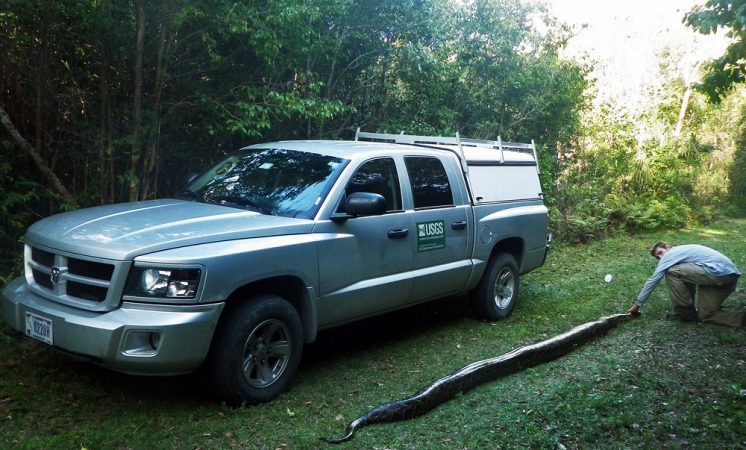
B.J. Smith/USGS
Back at the lab, three days afterwards, Hart's team implanted four devices into the snake: cardinal radio-transmitters, a GPS device to track the precise ground coordinates of the animal at every last times and an accelerometer. The last device derriere measure movements in three dimensions. The scientists then released the enormous snake gage into the Everglades.
Each device transcribed OR broadcast its position four multiplication a second. That's 345,600 multiplication a day. Powering the instruments to exercise this put a big drain on their batteries. That's why the devices had a useful life of lone about 40 years.
So on April 19, 38 days after returning P-52 to the Everglades, scientists trekked back in and caught her one antepenultimate clip. Spinal column in their laboratory, they removed her trailing instruments, killed the snake and stored her body for consider. Those investigations began on Venerable 10.
Unmasking the snake's doings
Burmese pythons are invasive snakes, meaning they are invading territory to which they are not native. And these big and hungry snakes are proving specially blasting to the ecosystems of southern Florida. The National Park Serving has a rule that when so much invasive species are ground, they must be killed to limit the damage they stern do.
Hart's team mustiness orison the park service to temporarily ignore that linguistic rule systematic to catch and release pythons in the Everglades. It's the only way the scientists can buoy get down to understand the doings of these animals, Lorenz Hart explains. Despite the snakes' huge Numbers, she observes, a Lot of basic questions continue unanswered, such as: How oft do they breed? How out-of-the-way do they travel in a given week or calendar month? How often do they eat?
One might expect that finding answers would be as simple as phoning reptilian experts in Southeast Asia, where the snakes occur from. "And we are talking with scientists at that place," says Michael Dorcas, at Davidson College in Tar Heel State. "Unluckily," he has learned, "we probably know more about pythons in south Florida than approximately them in their native grasp." The reason: Scientists have not studied the snakes much where they developed and became a natural part of the landscape.
As a herpetologist, Dorcas is a life scientist World Health Organization specializes in reptiles and amphibians. But he's as wel an ecologist, which agency he tries to understand how an animal fits into its environment — or doesn't. And many invasive species, like this python in Florida, have the electric potential to entirely disrupt and modify an environs that's new to them. This typically occurs if an incoming species lacks predators. Without something in a higher place the food chain to eat them and keep their numbers in check, members of an introduced species can transform an ecosystem.
Dorcas' work has helped establish that Burmese pythons have indeed been bullying their surroundings. Earlier this year, he light-emitting diode a group of scientists who showed that the snakes have been eating their way through the Everglades, leaving a drastically denatured ecosystem in their wake.
Raccoons, opossums, cervid and other mammals, along with birds and alligators, have all turned astir in the stomachs of captured pythons. And the scientists found that as soon as the pythons dilated into a new domain, the number of feed animals thither fell. In portions of the Everglades where these pythons have been present longest, convinced prey species appeared to nearly disappear, Dorcas told Science Intelligence.
Warm Florida
One big advantage that Burmese pythons throw over many of their prey — a slow metabolism. This is the rate at which personify processes pass off. Beingness warmed-blooded, mammals and birds breathe quickly and circulate their blood rapidly to regulate their body temperature. Powering these processes takes a lot of energy obtained from food. Cold-blooded pythons, however, don't need food to fuel their blood heat.
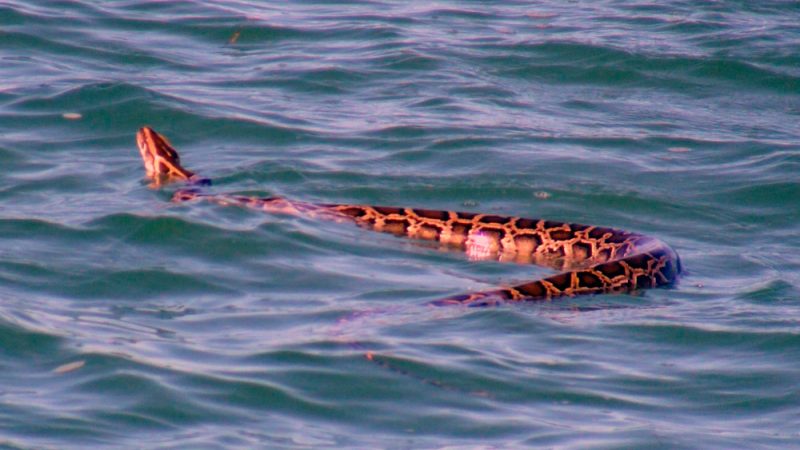
A Burmese python swims in Florida Bay. A fishing guide snapped its show on November 16, 2011. The snake was liquid in the focal point of the island End Cardinal. USGS/Camp Walker
This "allows pythons to do things that we arse't," Dorcas says. "For example, in many a instances a large Burmese python, if IT's healthy, could go a year or much without eating." So if the number of prey animals falls, a python just rests quietly and waits for prey to reproduce. Rabbits, deer and birds can't survive months — or, in or s cases, even years — waiting for their next meal.
Lorenz Milton Hart points to some other of this ophidian's advantages. Unlike many baby animals that are vulnerable at birthing and need some time to accommodate to their environment, "Child pythons are just raring to go, right out of the egg."
These animals are also quite comfortable in the Everglades. Although they need freshwater to survive, they don't need to boozing it. They can get the irrigate they indigence from the bodies of the animals they eat, Hart says. And the snakes are dustlike swimmers. Her team has observed some traveling across seawater, far from land. That seems to excuse why Burmese pythons give been found connected islands (known Eastern Samoa the Keys) that are at least 18.5 miles (30 kilometers) inactive of the Sunshine State mainland.
The main limit in their tumbling onto those islands would be access to freshwater, for drinking, along the manner. But especially after a storm, Hart notes, rafts of floating debris oft develop. The cratered surface of a branch, the cupped open of leaves or a piece of fictile could each hold little pools of freshwater. Operating room a natation yogurt cup might pick up a bit of rain. Hart suspects these snakes are quite adept at determination enough freshwater from sources such as these, even out while at offshore. "So it's non inconceivable," she says, "that these snakes can go from island to island."
Safekeeping track
Hart would equivalent to try and confirm the snakes' island hopping by fitting those in coastal areas with tracking devices. Simply there are two problems with that idea right now.
First, to slow the snakes' spread, there's that park requirement that scientists kill all pythons that they receive. "So it would be a little dangerous to put on them out at the coast, where they might swim off," she says — even though this "may be the only path that we can determine how long it takes them to get a sure distance across a saltwater barrier." Second, trailing devices can be damaged operating theatre destroyed past saltwater. And that means that if a snake did go to sea, scientists might lose their ability to later find and recapture IT.
Tracking devices are changing all of the sentence, however. So it's possible that newer models will set aside well-behaved real-time trailing of snakes, even at sea. Such devices could give up valuable information about where to promote snake surveillance programs, Hart says.
Each Burmese Python that receives tracking implants provides a wealthiness of new data for scientists. For instance, those devices used in P-52 will demonstrate where and how often she Ate. Key to it information will embody the accelerometer she carried. It prerecorded how she moved — much American Samoa whether she traveled in a straight line, pronounceable or coiled. That last movement can be especially telling because pythons are constrictors. That means they kill by wrapping or so their target and slowly, steadily wrapping tighter until their dejeuner can no longer emit.
"They often constringe with a type of motion where their belly goes up," Hart explains. "And that's not a normal position for a snake." So her squad looks for those belly-up movements, how long they lasted and where the snake was when it occurred. Past co-ordinated the precise times of these movements with GPS data happening the snake's location during those periods, her team can begin to name the habitat in which the snake had been dining. Was it a alligator's pond? In a tree? Or perhaps in a dense thicket at night?
By counting the act of those eating events and comparing them with weather records, biologists might also learn whether feeding increases when it's rainy or hot. They might eve key out whether the snakes are more belik to snack during seasons when slow and unwary child mammals are first venturing out into the surround.
Tail data
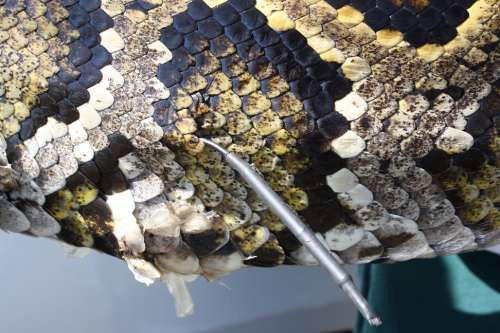
Scientists would like to know how closely related the Everglades pythons are to one other. To study this, Hart and early biologists snip off a piece of the tail of all python they snap. So they record its DNA to compare against that of the other pythons caught in Florida.
If the DNA show these animals are very closely related, this would suggest that right a few initial snakes served as the great-eager-great grandparents of all pythons in the Everglades. Put another way, that would mean the release of just a few snakes launched the large, intimidation assault this species has been carrying unfashionable on the Everglades' ecosystem. But if many of the snakes show little relatedness, that would indicate at that place has been a continuing acquittance of pet snakes terminated time into the park.
And that might exist sainted news for Python-free areas. It would suggest that it power take the release of a somewhat pack of snakes before a stable wild population exists that can reproduce.
Stag's team up is also analyzing snippets of Hydra tails for pollution studies. Mercury is a toxic element that can envenom animals, including people. IT's tending off by coal-unemployed power plants and other facilities. Ofttimes information technology moves finished marine environments, tainting fish, the birds that eat fish, and other animals.
By studying tissue from snake tails, Hart's team up has found that pythons can have high concentrations of mercury. If the baby snakes in P-52's eggs are well industrial adequate, the biologists volition look for see whether mom passed some of that atomic number 8 on to her young.
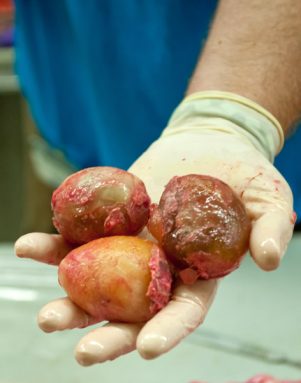
And about those eggs: Scientists at the Florida Museum of Natural Story retrieved huge handfuls from the register-breaking python. "There are not galore records of how many eggs a large female snake carries in the uncivilized," says Everglades Status Parking lot biologist Skitter Snow. The load in P-52 "shows they're a really reproductive animal," atomic number 2 says, "which aids in their invasiveness."
After studies of P-52 are completed, her body will equal affixed and showcased at the museum for five years. Later, it volition be returned to Everglades National Park. There it will serve as a potent symbol of the wallop of just one introduced species in a wild environs.
This video recording starts with still images of USGS researchers using a energy tracker to hunt for P-46 in Marching music. Researchers then find a python hidden in saw grass, which leads to the first capture of record-breaking P-52. A video records her fascinate once again in April, the final time, as she's readied to be permanently separate from the raving mad. Credit: C. Puckett/USGS
Magnate Words
accelerometer An instrument for mensuration vibrations or a change in the rate of movement. The one being exploited with snakes rump criterion front changes in altogether three dimensions.
cryptic Having a behavior that is cryptical OR possessing the ability to hide past concealing itself inside the surrounding environment.
ecosystem The natural community of plants, animals and microorganisms that evolved to live conjointly in a particular set down with a particular climate. Examples admit tropical reefs, rainforests, mountain range meadows and polar tundra.
freshwater Water system that is non salty, such A rain down, rivers and lake water.
GPS device Global Positioning System is fugitive for Global Positioning System. This system uses devices that figure their position (in terms of latitude and longitude) from any place along the ground operating room in everyone's thoughts. They do this by comparison how long information technology takes signals from different satellites to reach them.
habitat The natural environment in which a plant Beaver State goat-like usually lives. This includes not only the structural surround (such as sand, soil, sway or water) but also the other organisms that contribution that ecosystem.
herpetologist A life scientist who studies reptiles and amphibians.
metabolism The chemical processes by which cells use Department of Energy and nutrients to make the substances that sustain life.
predator An animal that must capture and feed upon other animals to survive.
radio tracking Following the movements of an animal or object victimization a device that gives off radio waves. A receiver can pick over up those radio-oftenness waves to provide information on how far away the broadcast medium signalise is and in which direction. Many biologists implant devices that broadcast so much radio-wave signals to hold back track of animals in the wild.
reptile Crisp-blooded vertebrate animals, whose skin is covered with scales or horny plates. Snakes, turtles, lizards and alligators are all reptiles.
Word Find ( click here to print puzzle )

0 Response to "Python-palooza!"
Post a Comment